Most women guess wrong here. That’s not an insult; it’s just what the research shows.
One study found women correctly identify a yeast infection on their own only about a third of the time. The rest end up putting antifungal cream on something that isn’t actually a yeast infection, or waiting out BV thinking it’ll clear on its own.
Here’s why the mix-up happens so much. BV and yeast infections share a lot of the same ground: itching, discharge, that general “something’s off” feeling. But they come from completely different things: one’s bacteria, one’s fungus, and they need completely different treatment. Get it backwards, and you’re stuck with symptoms for another week, maybe two.
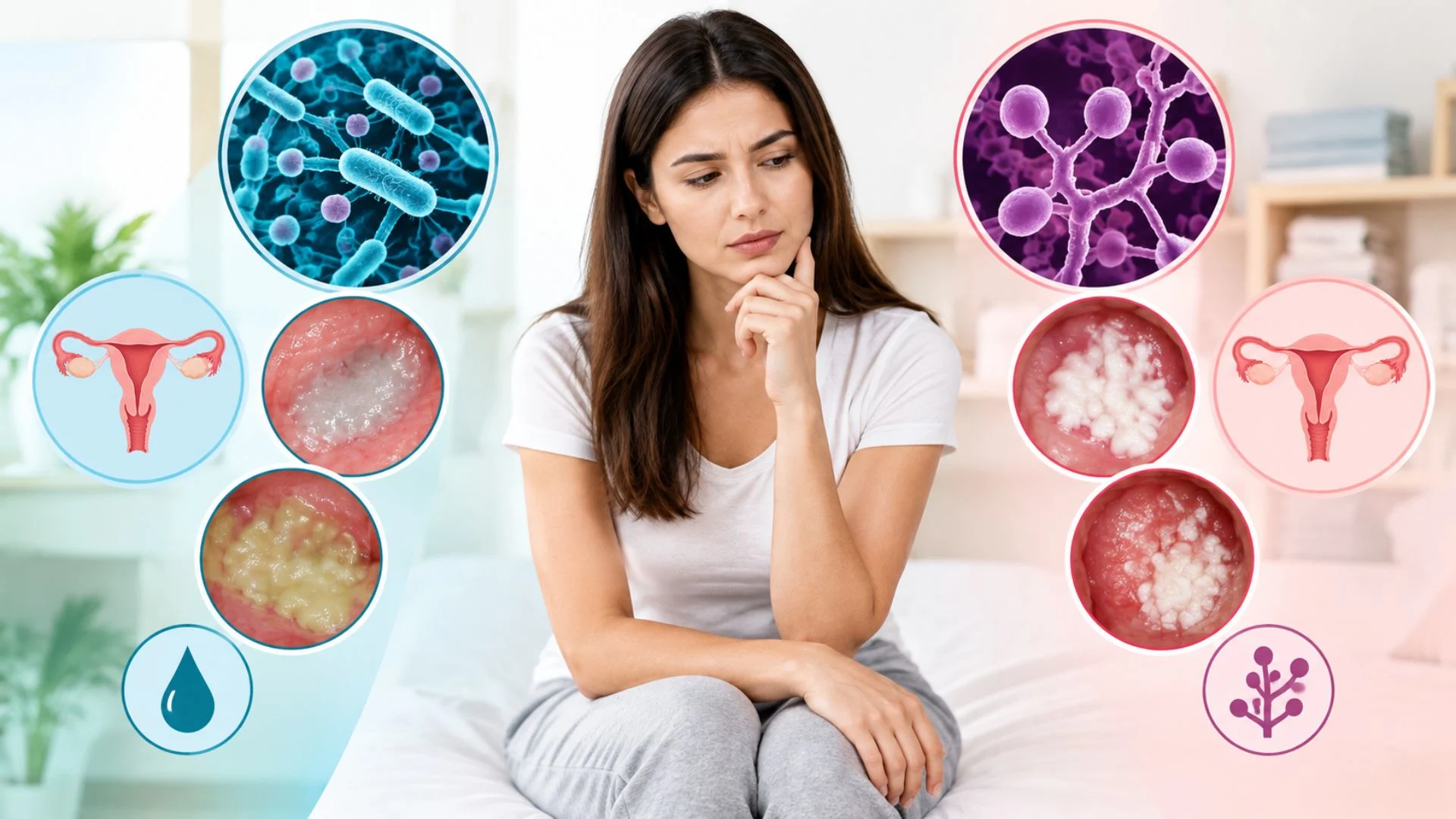
So let’s start with the one shortcut that actually helps. Thick, white, clumpy discharge, the stuff everyone compares to cottage cheese? That’s yeast, almost every time.
Thin, watery, grey discharge with a smell that hits you? That’s BV. There’s more to it than that, obviously, but if you remember nothing else from this, remember that.
What Is BV and What Is a Yeast Infection?
Both of these get filed under “vaginitis,” which is just a medical way of saying your vagina is inflamed. Doesn’t tell you much on its own, though. The real difference is in what’s causing it.
What is Bacterial Vaginosis?
Your vagina has good bacteria living in it all the time, doing their job quietly. BV shows up when that balance gets thrown off, and a bacterium called Gardnerella vaginalis starts taking over space it shouldn’t.
It’s not an STI exactly, though new partners or multiple partners do raise your odds of getting it. About one in three women deal with BV in any given year.
And weirdly, a lot of them don’t even notice. No itching, no discharge they’d flag, nothing. It just sits there until a doctor finds it during a checkup.
What is a Yeast Infection?
You’ve got a little bit of Candida living in your vagina right now, whether you know it or not. Normally it stays small and causes zero trouble.
Something tips the scale, though- maybe antibiotics, maybe hormones- and Candida multiplies fast. About three in four women get hit with this at some point. Close to half get a repeat.
One thing worth knowing: antibiotics do nothing for this. Actually, they can cause it, since they wipe out the bacteria that was keeping Candida in line to begin with.
What Sets Each One Off: Causes of BV and Yeast Infections
Here are the most common causes behind BV and yeast infections:
BV tends to show up after:
- New or multiple sex partners
- Sex without a condom
- Douching (seriously, just don’t)
- Smoking
- Hormone changes from your period, pregnancy, or menopause
A yeast infection tends to show up after:
- A round of antibiotics
- Eating a lot of sugar
- Wearing tight, non-breathable clothes for too long
- Birth control or pregnancy
- A weaker immune system
- Blood sugar running high
Funny enough, these two are connected. Treat BV with antibiotics, and a few days later you might find yourself dealing with a yeast infection instead.
Antibiotics usually clear BV, but up to 60% of women get it again within six months.
The medicine that fixed one problem opened the door for the other.
Symptoms Comparison: BV vs Yeast Infection
Here is how an easy comparison between BV and yeast infection looks like:
| Bacterial Vaginosis (BV) | Yeast Infection | |
|---|---|---|
| Discharge | BV usually causes thin and watery discharge. The discharge may look white or grey. | A yeast infection usually causes thick, white, clumpy discharge. It is often compared to cottage cheese. |
| Smell | BV often causes a strong fishy smell. The smell may be more noticeable after sex. | A yeast infection usually does not cause a strong smell. |
| Itching | BV usually causes little or no itching. | A yeast infection often causes strong itching around the vagina and vulva. |
| Redness and swelling | BV usually does not cause much redness or swelling. | A yeast infection can cause redness, swelling, and soreness around the vagina and vulva. |
| Burning | BV may cause some burning, especially when you pee, but it is not always present. | A yeast infection can cause burning, especially when you pee or when the area is irritated. |
| Vaginal pH | BV usually raises vaginal pH above 4.5. | A yeast infection usually does not change vaginal pH much. |
| Main clue | Thin discharge with a fishy smell is a common sign of BV. | Thick, white discharge with strong itching is a common sign of a yeast infection. |
Discharge is your best clue.
BV gives you thin, watery stuff, grey or white. Yeast gives you thick, clumped discharge, the cottage cheese texture people describe.
Smell narrows it down fast. BV often has a fishy odor, worse after sex. Yeast usually has no smell at all.
Itching is the giveaway most people notice first.
BV barely itches, if it itches at all. Yeast itches, and not a little. Add redness, swelling, burning when you pee, that’s yeast talking.
pH is something your doctor checks, not something you’ll notice yourself, but BV pushes it above 4.5 while yeast barely moves the needle.
Smell is the tiebreaker.
Fishy, especially right after sex, points to BV. No smell with that cottage cheese look; that’s yeast. Small tip: write down what you’re noticing before you call a doctor. “It’s thick and white and doesn’t smell” gets you a faster, better answer than “something’s wrong down there.”
How to Tell If You Have BV or a Yeast Infection?
The following two things can help you to indicate whether you have a BV or yeast infection:
Reading Your Discharge
Texture tells you the most. Clumpy and thick, almost always yeast. Thin and watery, almost always BV. Sometimes BV discharge has a slight yellow or green tint to it too, whereas yeast stays pretty much plain white.
Why Your pH Matters
A healthy vagina stays under 4.5, and good bacteria are the reason why.
- BV pushes that number up because bad bacteria have moved in.
- Yeast barely changes it since the problem isn’t bacterial to begin with.
You can actually buy pH strips at a drugstore and test yourself at home. High reading plus fishy smell, probably BV. Normal reading plus cottage cheese discharge, probably yeast.
Diagnosis and Testing: How a Doctor Actually Figures This Out?

Here is how both the conditions are diagnosed:
How BV Is Diagnosed
For BV, there are a few tests run together. One’s called the whiff test, checking for that fishy smell when your discharge sample gets mixed with a solution. Another looks at your cells under a microscope for what’s called clue cells, basically cells coated in bacteria. Your pH gets checked too. Hit enough of these markers, and you’ve got a BV diagnosis.
Testing matters for another reason too. A 2026 study in the Journal of Clinical Microbiology found that women with BV confirmed by a lab DNA test were 1.85 times more likely to also have an STI. So if your symptoms keep coming back or don’t seem clear, getting the right test can tell you more than guessing based on discharge or smell.
How Yeast Infections Are Diagnosed
For yeast, a sample goes under the microscope to look for yeast cells and these thread-like structures called hyphae. If the first round of treatment doesn’t work, sometimes a culture gets run too, since a few strains of Candida don’t respond to standard treatment. Honestly though, a lot of doctors just look at your symptoms and call it, since the pattern is pretty distinct.
Getting Rid of It: Treatment Options for BV and Yeast Infections
Having these infections really sucks, and proper treatment is required for better health. Have a look at what can help:
Treatment For BV
Antibiotics, no way around it. Metronidazole is usually the first choice, either a pill or a gel you use vaginally.
Clindamycin cream is the backup option. Symptoms usually calm down in a couple of days, but finish the whole prescription anyway; stopping early just invites it back.
And it does come back a lot, within a year for a good chunk of women. Some doctors will add a probiotic or boric acid alongside the antibiotics to deal with what’s actually causing the imbalance.
Treatment For Yeast
Antifungal cream, miconazole or clotrimazole, both sit right on the shelf at any pharmacy. Works fine for most cases.
If you’d rather skip the cream, fluconazole is a single pill your doctor can prescribe.
Getting four or more of these a year counts as recurrent, and that usually means a longer treatment plan or a different medication. Probiotics help here too, especially if antibiotics are what triggered things in the first place.
Can BV or Yeast Infections Come Back?
Yeah, probably, for both.
BV especially has a habit of returning, sometimes within months, since whatever threw off the balance the first time doesn’t always get fixed just by taking antibiotics. Left untreated, it’s been linked to a higher risk of STIs and pregnancy issues, so don’t brush it off even if the symptoms feel minor.
BV can also come back because of what is happening between partners. In a 2025 trial published in the New England Journal of Medicine, BV came back within 12 weeks in 35% of women whose partner was treated too. Among women whose partners were not treated, it came back in 63% of cases.
This suggests that for some couples, preventing recurrence may require looking beyond the person experiencing symptoms.
U.S. guidance has also started to reflect this. In December 2025, the American College of Obstetricians and Gynecologists updated its guidance on treating sexual partners to help lower the chances of BV coming back.
Yeast infections usually clear faster and cause fewer long-term problems, but if you’re getting them over and over, it’s worth checking things like blood sugar or overall immune health with your doctor.
Tips for Prevention: Keeping It From Happening Again
Preventing both BV and yeast infections will help avoid discomfort. Here are some tips that can be used:
Preventative Measures for BV
- Skip douching completely; it messes with your natural balance more than it helps.
- Use condoms if you’re seeing new partners.
- A Lactobacillus probiotic can support things too.
- Cotton underwear over synthetic, always.
A 2026 analysis of randomized trials found that vaginal probiotics were the only long-term prevention approach with a statistically significant effect. This adds to the growing research around restoring and maintaining protective bacteria in the vaginal microbiome.
Research is also looking at whether specific protective bacteria can be restored directly. In an early-stage 2026 trial, two-thirds of participants were colonized with protective Lactobacillus crispatus within five weeks, and those participants were less likely to experience BV again.
This is the thinking behind a microbiome-focused approach: treat the current problem, then work on rebuilding the protective environment that helps keep it from returning. At Conscious Medicine, the Revive step focuses on supporting that process rather than stopping at symptom relief.
Preventative Measures for Yeast Infections
- Cut back on sugar if you can; Candida loves it.
- Don’t sit around in a wet swimsuit or sweaty gym clothes.
- Take a probiotic during and after any antibiotics.
- Wear loose clothing when you can manage it.
When You Should Just Call a Doctor?
First time dealing with any of this, go get checked; don’t guess. If symptoms stick around after you’ve finished treatment, or keep coming back, or you notice bleeding or broken skin, that’s a doctor visit too.
Pregnant and noticing anything unusual? Call right away; don’t wait it out, since untreated BV has been tied to early delivery. And if your symptoms don’t cleanly match one pattern or the other, that confusion itself is a good reason to get tested instead of guessing.
Questions People Actually Ask
How do I know if it’s yeast or BV?
Smell first. Fishy means BV; no smell usually means yeast. Texture second. Thin and watery is BV; thick and clumpy is yeast. Itching last. Yeast itches a lot; BV barely itches at all.
Can you have both at the same time?
Yes, and it’s more common than people think, especially since treating BV with antibiotics can trigger yeast right after. If your symptoms feel like a mix of both, get tested for both instead of assuming.
Which one’s actually worse?
BV, long-term. Left untreated, it raises your risk for STIs and pregnancy complications. Yeast infections are uncomfortable but rarely turn into anything serious.
Does BV itch as much as a yeast infection?
Not even close. Most women with BV feel little to no itching. Intense itching almost always points to yeast.
Is a fishy smell always BV?
It’s the strongest sign, especially after sex, but not every case of BV smells. So no smell doesn’t rule it out completely. Yeast infections almost never smell, though, so if you’ve got a smell at all, it’s probably not yeast.
If You’re Dealing With BV That Won’t Quit: Talk to a Functional Medicine Provider
Treating the same flare-up over and over with antibiotics gets exhausting, and it doesn’t always fix what’s causing it in the first place.
Talking to a provider who looks at the whole picture- hormones, daily habits, and your vaginal microbiome- can help you actually break the cycle instead of managing the next round.
That is where looking deeper can make a difference. Testing can help identify what is actually happening, while microbiome-focused support can address the environment that may contribute to recurrence. For Conscious Medicine, that means investigating the underlying picture first and then working toward restoring a healthier vaginal ecosystem.
If you’re ready for answers instead of another prescription, it might be worth looking into root-cause support for bacterial vaginosis at Conscious Medicine.