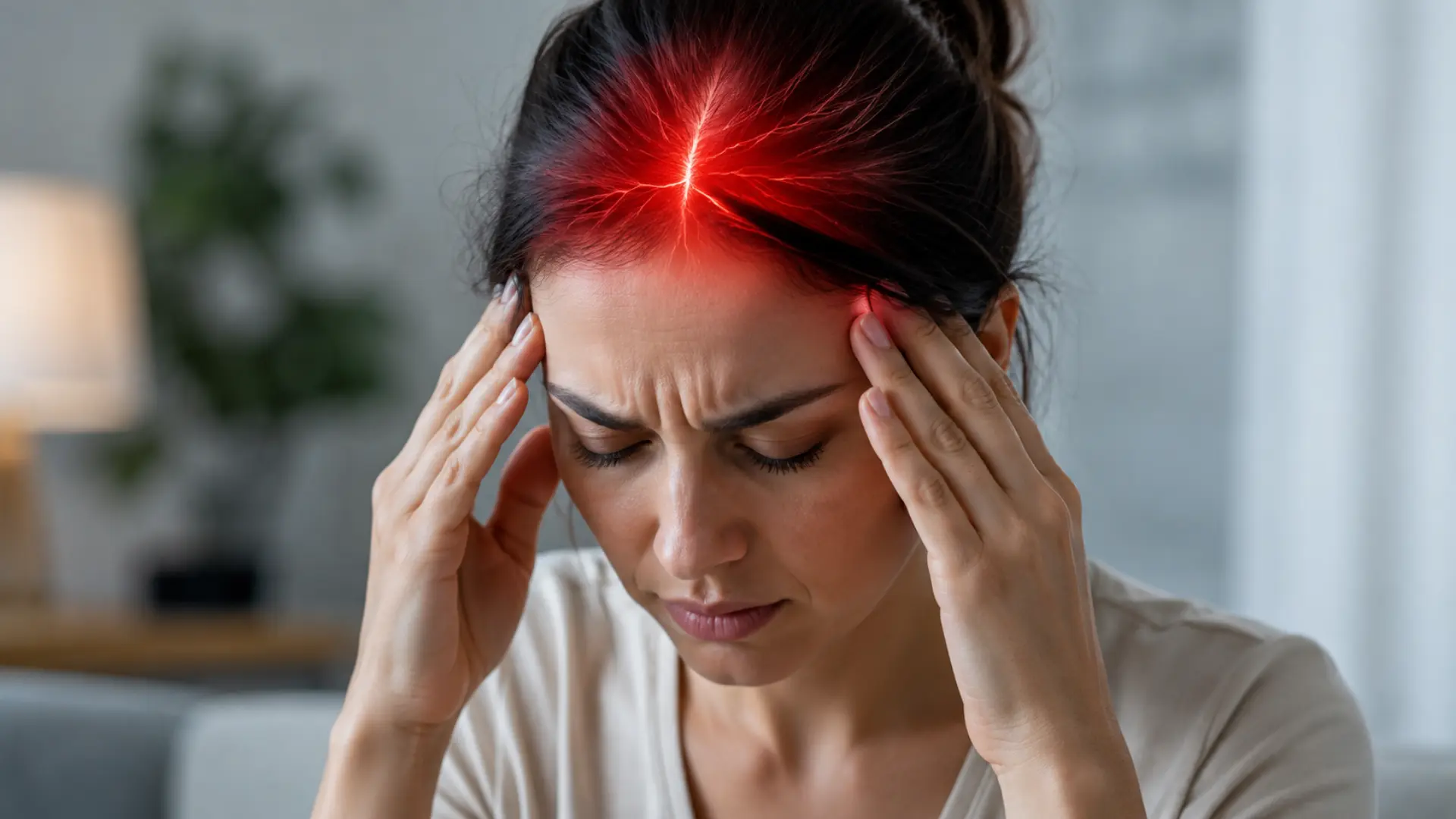
Top of your head hurts. Not the sides, not behind the eyes, right at the crown, like something’s sitting on it. Odd place to feel pain, honestly, and that’s part of why it worries people more than a regular headache would.
Below is a rundown of what usually does this, how to figure out yours, what actually works, and the short list of signs where you stop reading and go see someone.
What Does a Headache on Top of the Head Mean?
Doctors call it a vertex headache. Sounds serious. Usually it isn’t. Tight muscles, an irritated nerve, or your body dealing with something else entirely: blood sugar, dehydration, hormones swinging around.
Here’s the thing about your scalp and neck: they’re basically one connected system of muscle. Pain that starts down near your shoulders has nowhere to go but up, and up means the crown.
So no, this isn’t usually your brain telling you something’s wrong. It’s muscles clenching. Nerves getting pinched somewhere they shouldn’t be. Blood vessels opening and closing faster than they should. Find what triggered it and half the battle’s already won.
12 Causes of Pain on Top of Your Head
Here are the most common causes for headache on top of head:
1. Tension-Type Headache
This one hits almost everyone at some point. The World Health Organization says tension headaches affect nearly 1.9 billion people worldwide. That’s not rare. That’s most of us.
Long hours at your desk cause this. So does staring down at your phone. So does clenching your jaw without even knowing you’re doing it.
All that tightens the muscles across your scalp. Then down into your neck. The pain feels like a band wrapped around your head. Pressing evenly. Not throbbing.
Most of these headaches last 30 minutes to a few hours. Chronic cases can stretch for days, though. Stress is the top trigger doctors hear about. Poor posture comes right after it.
2. Neck Strain and Cervicogenic Headache
Your neck muscles attach right at the base of your skull. They run up over your scalp too. Strain those muscles and pain has one direction to travel. Up.
Research on chronic headaches puts cervicogenic cases at 15 to 20 percent of the total. That’s a bigger number than most people guess.
Sleeping with your neck twisted causes this. Looking down at your phone for hours does too; people call it text neck now. A rough workout can strain things enough to trigger it as well.
Here’s a simple test. Turn your head slowly side to side. Pain getting sharper as you turn? Your neck is likely the cause.
3. Migraine
Most people think migraines only sit on one side of the head. Not true for everyone. The American Migraine Foundation found that about 1 in 3 migraine sufferers feel pain shift location. Sometimes it lands right at the top instead.
What makes a migraine different from a regular headache is everything that comes with it. Nausea. Sensitivity to light. Sensitivity to sound. A pulse you can feel pounding, almost in time with your heartbeat.
Migraines affect roughly 12 percent of people. Women get them nearly three times more than men do. Hormones play a big part in that gap.
Left alone, without treatment, an episode can run four hours. Or it can run three full days. Big range, but that’s the reality.
Read more: 5 Tips For Instant Migraine Relief That Actually Works?
4. Occipital Neuralgia
Two nerves run from the base of your skull up to the top of your head. Doctors call them the greater and lesser occipital nerves. Pinch these nerves and the pain feels nothing like your usual headache.
Tight neck muscles cause this pinch often. So can an old injury. So can arthritis higher up in the spine.
Patients describe the pain as sharp. Stabbing. Some say it feels electric, like a jolt shooting through the scalp. Not a dull ache at all.
This condition shows up less often than tension headaches or migraines. But doctors see it more in people who sit with bad neck posture all day. Desk workers. Gamers. People glued to screens.
5. Dehydration
Your brain sits inside a cushion of fluid. That fluid level shifts depending on how much water is in your body. A study in Frontiers in Neurology found that losing just 1 to 2 percent of your body water can bring on a headache within hours.
Small water loss shrinks brain tissue a tiny bit. That shrink pulls on the tissue and blood vessels around it. Your brain reads that pull as pain. Often right at the crown.
Good news here, though. Fix the water problem, and most people feel better within 30 minutes to an hour. Fast turnaround for such a simple fix.
6. Blood Sugar Drops
Your brain burns through energy fast. It uses about 20 percent of your body’s total energy, despite weighing in at only about 2 percent of your total body weight. Skip a meal, and that fuel supply drops quickly.
Doctors call this a hypoglycemia headache. It usually shows up a few hours after your last meal. Shaky hands often come with it. So does trouble focusing. So does a short temper for no clear reason.
People on insulin or certain diabetes medications face a higher risk here. But truthfully, anyone who skips meals can trigger this. Doesn’t take a health condition to cause it.
7. Sleep Disruption and Sleep Apnea
Bad sleep lowers how much pain your body can handle the next day. Headaches that would normally feel mild suddenly feel worse. Sleep apnea takes this even further.
The American Academy of Sleep Medicine reports that close to 1 in 5 people with obstructive sleep apnea deal with morning headaches. The cause is oxygen levels dropping repeatedly through the night.
These headaches usually show up within minutes of waking. They tend to fade within an hour or two on their own. But the pattern repeats every single night until the sleep problem gets fixed.
Snoring is a warning sign worth noting. Daytime tiredness is another. Waking up gasping for air is a big one too. Mention these to a doctor if they sound familiar.
8. Medication Overuse Headache
This cause surprises people the most. The International Headache Society defines it clearly. Pain showing up 15 or more days a month, in people who take pain medication more than 10 to 15 days a month.
Here’s how the trap works. The medicine wears off. Pain returns. You take more medicine. Over time, your body starts expecting that dose just to feel normal.
This cycle can turn an occasional headache into a near-daily problem. Breaking it usually means stopping the medication, but that needs to happen under a doctor’s guidance. Not on your own.
9. Hormonal Shifts
Estrogen controls blood vessels in your brain more than people realize. Its levels swing hard during your period. During pregnancy. During menopause too.
A study published in the journal Menopause found that up to 60 percent of women who get migraines see a clear link to their menstrual cycle. That’s a strong connection, not a small coincidence.
The drop in estrogen right before your period starts gets blamed the most. This drop often causes headaches that settle right at the crown. Birth control and hormone therapy can make this better or worse, depending on the person.
10. Hair Traction
Doctors call this a traction headache. It comes from constant pulling on your scalp. Tight ponytails cause it. So do braids. So do buns. So do headbands worn too long.
All that pulling irritates nerve endings across your scalp. The pain settles wherever the pull is strongest, usually right at the crown or along the hairline.
Dermatology research warns this isn’t just a headache issue either. Long-term pulling can cause hair thinning at those exact spots, a condition called traction alopecia.
The fix is simple, at least. Take your hair down. Most traction headaches fade within 30 to 60 minutes after that.
11. Sinus Pressure
Your sinus cavities sit behind your forehead. Behind your cheeks too. Between your eyes as well. Infections or allergies inflame these spaces and pressure builds up inside.
Most sinus pain stays in the face. But that pressure can travel upward toward the crown. Especially when the frontal sinuses, the ones right above your eyes, are involved.
The CDC reports that sinus infections hit around 1 in 8 adults in the United States every year. That makes this one of the more common seasonal causes, especially bad during allergy season or right after a cold.
12. High Blood Pressure
Most people with high blood pressure feel nothing at all. That’s exactly why doctors call it a silent condition. Headaches from blood pressure usually only show up once numbers hit dangerous territory.
The American Heart Association marks that danger zone above 180 systolic or 120 diastolic. That’s called a hypertensive crisis. Below that, blood pressure rarely causes head pain on its own.
When a headache does show up at this level, it often sits right at the top of the head. Blurred vision might come with it. Chest pain too. Shortness of breath as well.
This combination is not a normal headache. It’s a medical emergency. Blood pressure that high raises stroke risk fast, within a short window of time.
The Root Cause Question Most People Skip
Pain hits, hand goes for a pill. That’s the whole routine for most people. Nobody pauses to ask why the pain showed up to begin with.
So pause. Ask yourself:
- Water today? Real water, not coffee, not soda.
- Eaten on schedule, or running on empty since breakfast?
- Sleep last night, actual sleep?
- How long have you been staring at that screen without looking away?
- Hair pulled back tight this very second?
- Popped headache pills how many days running now?
Answer those honestly. You’ll land on the real cause faster than any medicine cabinet gets you there.
How to Tell Which Headache You Have?
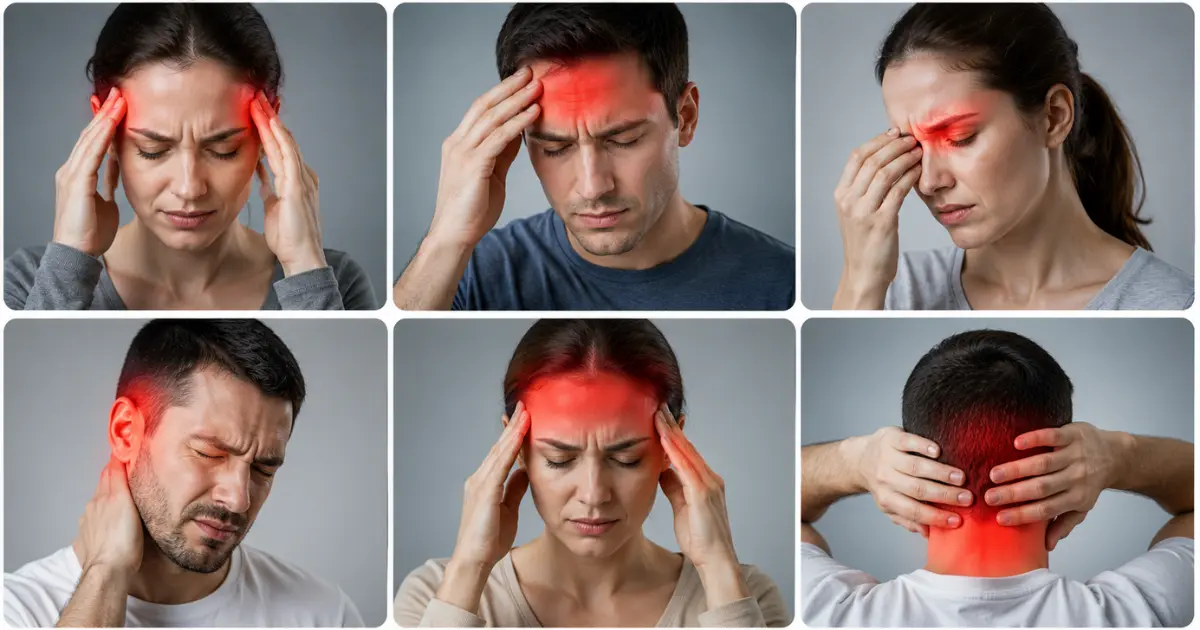
Location plus whatever else you’re feeling- that combo tells you almost everything you need to know.
- Tight band, whole head. That’s tension.
- Worse turning your neck? Cervicogenic, blame the neck strain.
- Throbbing and nauseous, lights too bright. Migraine, most likely.
- Sharp like a shock running through. Occipital neuralgia.
- Dry mouth, dark urine alongside it, that’s dehydration talking.
- Shaky a couple hours after you ate. Blood sugar crashed on you.
- There the second you wake up. Sleep’s the issue, maybe apnea.
- Back the moment your last pill wears off. Medication’s overusing you, not the other way around.
- Timing lines up with your cycle. Hormones, plain and simple.
- Gone once your hair’s down. Traction, nothing more.
- Stuffy nose, pressure in your face too. Sinus related.
- Vision’s off, chest feels tight. Blood pressure, get checked today.
Red Flags: When to Get Emergency Care?
Most of what’s listed above is harmless in the end. A few things aren’t. ER territory looks like this:
- Sudden, and worse than any headache you’ve had before.
- Stiff neck. Fever. Both showing up together.
- Words slurring, one side going weak, vision blurring out.
- Hit your head not long ago; headache followed after.
- Reading above 180 over 120 on the blood pressure cuff.
- Getting worse each day instead of settling down.
- Over 50, and this one feels nothing like your usual.
One single item off that list, that’s enough. Go. Don’t wait to see if it passes on its own.
Fast Relief for a Headache on Top of Your Head
Work down this list.
- Water. A full glass, right now. Dehydration’s behind more of these than people ever guess, and it costs you nothing to check.
- Skipped a meal recently? Fix that next.
- Screen off for ten minutes. Look at something across the room instead.
- Fingers to the base of your skull, slow circles, work your way up.
- Cold on the forehead or warm on the neck, whichever your body prefers.
- Hair down. Immediately, if it’s been up and tight.
- Outside for a few minutes, fresh air, if you’re able to.
- Only after all that, reach for over-the-counter medicine, and don’t go past two days a week doing this.
How Can You Prevent a Headache on Top of Your Head?
Small stuff, repeated daily, adds up fast.
- Sip water all day instead of chugging it once you’re already thirsty.
- Meals on a schedule. Breakfast included, no skipping.
- Every hour at your desk, stand up, stretch, even just for a minute.
- Phone at eye level, not craned down toward your lap.
- Same bedtime, same wake time; weekends don’t get an exception.
- Long day ahead? Skip the tight hairstyle.
- Notes app, track every headache. Patterns with your cycle, your sleep, your meals show up fast once it’s written down instead of guessed at.
Do Your Headaches Keep Coming Back?
Once in a while, that’s just being human. Twice a week or more, that’s a different story.
Book that appointment with a doctor if:
- You’re past two headaches a week, consistently.
- Your usual over-the-counter fix stopped doing its job.
- Something changed recently, and you can’t point to why.
- Work, sleep, or daily life is taking the hit because of this pain.
A doctor checks blood pressure, checks for sleep apnea, checks the nerves, and actually builds a plan around your real cause. Beats guessing alone at 2 am with a search engine.
Find Real Relief With Conscious Medicine
Twelve causes. One pattern running through all of them. Your body sends a signal before things go wrong, and a headache at the top of your head is one way it speaks up.
Maybe you have already tried the usual list. Medication. Stretching. Cutting back on screen time. Some relief, but the headaches keep circling back anyway. That’s often a sign the real cause never got addressed in the first place.
At Conscious Medicine, we look past the pain itself. If chronic headaches or migraines have been running your life long enough, it might be time to look deeper than the next pill. Reach out to Conscious Medicine and let’s find out what your body has been trying to tell you.
Frequently Asked Questions
What Does a Headache on Top of the Head Mean?
Tight muscles most of the time, sometimes an irritated nerve, sometimes your body flagging something else, low blood sugar, dehydration, hormones. What’s behind yours depends heavily on timing and whatever symptoms are riding along with the pain.
Is a Headache on Top of the Head Serious?
Usually not. Water, food, a bit of rest, and it’s gone. Gets serious fast though if there’s sudden severe pain, vision trouble, weakness, fever, or a recent knock to the head involved. Any of those, doctor immediately.
Why Do I Wake Up With a Headache on Top of My Head?
Bad sleep quality’s the usual suspect, or grinding your teeth overnight, or sleep apnea running the show. Oxygen dropping from breathing that keeps stopping and starting leaves pain waiting for you the moment your eyes open.
What Causes Sharp Stabbing Pain on Top of the Head?
Occipital neuralgia, most likely, nerves at the base of your skull getting pinched somewhere they shouldn’t. Nothing dull about it either; this one feels like a jolt, not a press.
Why Is the Top of My Head Sore to the Touch?
Tight scalp muscles usually, or a tension headache brewing, or a hairstyle that’s been pulling too hard for too long. Irritated nerves sometimes make even a light finger tap feel tender.
Does Dehydration Cause a Headache on Top of the Head?
It does, more often than most people would guess. Even a small drop in your body’s water shrinks brain tissue slightly, tugging on everything around it. Drink up, and relief often shows within the hour.
How Long Does a Vertex Headache Last?
Dehydration or hunger versions last thirty minutes to an hour; fix the cause, and it’s gone. Migraines stretch from four hours to three full days. Nerve pain comes in short, sharp bursts rather than one continuous stretch.
What Relieves a Headache on Top of the Head Fast?
Water first, always. A snack if you’re running on empty. Scalp massage. Hair down if it’s tight. Cold or warm compress on top of all that for good measure.
Does Anxiety Cause Pain on Top of the Head?
Yes, absolutely. Anxiety clenches muscles across your scalp, your neck, your shoulders, and that tension lands right at the crown more often than not. Breathing exercises, short breaks scattered through the day, both help cut this down.
Why Does the Top of My Head Hurt During My Period?
Estrogen takes a sharp dive in the days right before your period starts. Blood vessels in your head feel that drop, and pain at the crown is a common result.