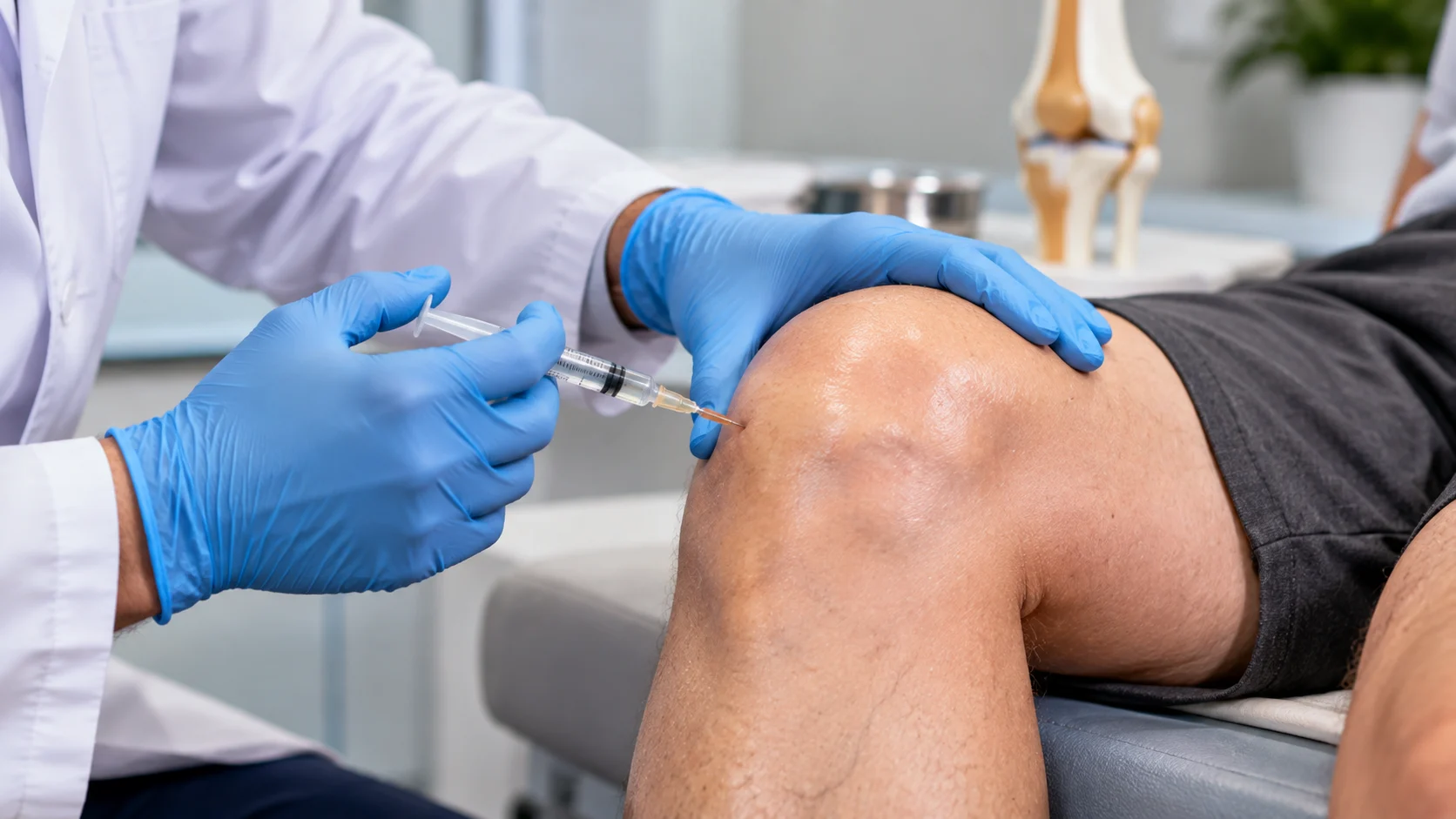
Your knee’s got osteoarthritis. Your doctor brought up gel injections. Before you say yes to a needle in your joint, you probably want the real story on what it actually does to your body.
Here’s how it usually plays out. Most people end up with a sore, swollen knee for a day or two, and that’s the whole experience. A smaller group gets a reaction rough enough to need attention within hours. And a rare few end up with an infection, which is a genuine emergency.
Figuring out which of those three camps you’re in matters a lot more than trying to memorize every possible side effect on some list.
This guide covers the common stuff, the rarer stuff, the signs that mean pick up the phone today, and what actually pushes your personal risk up or down.
Quick answer
Pain, swelling, warmth, and stiffness right at the injection site are the most common side effects of knee gel injections, and they typically clear up within one to three days. Around 1% of patients get something called an injection flare, where the joint swells up hard and hurts enough that the fluid has to be drawn out. Joint infection is rare, but when it happens, it’s a real emergency. Allergic reactions mostly come from brands made with avian protein.
What knee gel injections are
A knee gel injection puts hyaluronic acid straight into the joint space. Doctors call this viscosupplementation, a word that makes it sound way more complicated than it actually is.
Your body already makes hyaluronic acid on its own. It’s part of synovial fluid, the stuff that cushions and lubricates your joints. Osteoarthritis chips away at both how much of that fluid you have and how well it functions. The injection is essentially topping the tank back up.
The FDA has only signed off on hyaluronic acid injections for the knee specifically. Anywhere else, and it’s considered off-label use.
Two things worth remembering before diving into the side effects. First, this treats symptoms. It doesn’t reverse or stop the joint damage itself. Second, people respond all over the place. Some feel relief in days. Others wait weeks. Some never notice a difference at all.
Common side effects of knee gel injections
These show up in a fair number of people and clear up on their own, no drama.
Injection site pain: Soreness right where the needle went in, usually hanging around for 24 to 48 hours.
Joint swelling: A bit of fullness in the knee as it adjusts to the extra fluid.
Warmth around the joint: The area warms up a little, just tissue doing what tissue does. Nothing alarming.
Stiffness and reduced range of motion: Bending the knee feels tight for a day or two.
Bruising: More common if you’re on blood thinners or taking a lot of fish oil.
What actually helps here: ice, wrapped in a towel, 15 to 20 minutes at a stretch. Skip long periods of standing, running, or lifting heavy stuff for a day or two after the shot.
The pattern you want to see: things peak in the first few hours, then steadily improve from there. If it’s getting worse by day two instead of better, that’s a reason to call.
Uncommon side effects of knee gel injections

Here are some uncommon side effects of knee gel injections:
Injection flare, also called a pseudoseptic reaction
Worth slowing down on this one, because people confuse it with infection all the time, and it’s usually behind the scarier stories floating around online.
About 1% of patients get a sharp inflammatory reaction after getting the shot. Fluid piles up in the joint. The knee swells hard, hurts enough that walking gets difficult. Usually shows up somewhere between 24 and 72 hours after the injection.
Here’s the important part. This is inflammation, not infection. Your provider draws the fluid out to relieve the pressure, and it goes away without leaving any real damage behind.
Risk seems to climb with cross-linked, higher molecular weight products, and it tends to increase with repeated rounds of the same brand. If you react once, switching brands next time is a reasonable call.
Allergic reaction
Some hyaluronic acid brands are made from avian protein, meaning rooster combs, believe it or not. Others come from bacterial fermentation and have zero animal material in them.
Tell your provider ahead of time if you’ve got a chicken, egg, or feather allergy. Going with a bio-fermented product sidesteps that whole issue.
Watch for hives, itching that won’t quit, rash, swelling around the face or throat, or trouble breathing. Anything involving your breathing means get emergency help right away; don’t wait it out.
Bleeding into the joint
Hemarthrosis isn’t common, but it’s more likely if you’re on warfarin, a direct oral anticoagulant, or high-dose antiplatelet meds. Bring your full medication and supplement list to the appointment so your provider actually knows the full picture.
Skin reactions at the site
Some people get blistering, burning, itching, numbness, tingling, discoloration, or small lumps under the skin. Most of it fades on its own without needing any real intervention.
Rare but serious: joint infection
Septic arthritis from an intra-articular injection is uncommon. But it’s serious enough that catching it early really does matter.
Bacteria that get into the joint multiply fast in synovial fluid, which doesn’t defend itself very well against that kind of thing. Left alone, septic arthritis can chew through cartilage within days.
Get same-day care if you notice:
- Fever above 100.4°F
- Knee pain that’s getting worse, not better, past 48 hours
- Trouble putting weight on the leg
- Redness spreading beyond the joint area
- Chills, sweats, or just feeling off overall
How to tell an injection flare from an infection?
Both look similar at first glance: hot, swollen, painful knee. Here’s what actually tells them apart.
Timing: A flare peaks within 24 to 72 hours, then starts easing up. Infection just keeps climbing past that 48-hour mark.
Fever: Flares rarely bring fever along. Infections usually do.
Systemic symptoms: A flare stays put in the knee. Infection brings chills, that run-down feeling, general malaise.
Trajectory: Honestly, this is the signal to trust most. Improving means flare. Worsening means call today, no waiting around.
Don’t try to diagnose yourself here, though. Knowing the difference just helps you describe what’s happening clearly when you do call, not talk yourself out of calling in the first place.
What raises your risk?

Product type: Avian-derived brands carry allergy risk that bio-fermented ones simply don’t.
Repeat courses: Reaction rates go up with repeated rounds of the same cross-linked product.
Injection technique: Ultrasound or fluoroscopic guidance improves accuracy. Fluid landing in surrounding tissue instead of the joint itself tends to trigger more local reaction.
Sterile technique: Infection risk tracks pretty directly with how well the skin and field were prepped.
Anticoagulant and antiplatelet therapy: Bumps up bleeding risk.
Active infection anywhere in the body: Injecting a joint while a systemic infection’s going on elsewhere raises the chance of seeding that infection into the joint. Reschedule if this is you.
Underlying inflammatory burden: People carrying more systemic inflammation tend to get bigger local reactions. This one gets talked about the least, and it’s actually the most changeable of the bunch.
The efficacy question you should ask alongside the safety question
Safety’s only one side of this. Effectiveness is the other, and honestly, doctors don’t fully agree on it.
The FDA has cleared hyaluronic acid for knee osteoarthritis. But major groups like the American Academy of Orthopaedic Surgeons and the American College of Rheumatology have put out guidelines that don’t back routine use here, pointing to effect sizes in pooled trial data that fall below what patients actually feel day to day.
So here’s the weird part. Individual patients genuinely report real relief. And pooled data across studies shows a pretty small effect overall. Both things are true at once, which is confusing, but that’s just how it is.
Practically speaking, a treatment with a modest average benefit deserves a real plan for figuring out if it worked for you specifically. Ask your provider what outcome, measured over what window of time, will actually decide whether a second round is worth doing.
A functional medicine perspective on joint pain
Gel injections deal with lubrication. They don’t touch why the joint broke down to begin with.
For a long time, osteoarthritis got chalked up to simple mechanical wear. These days there’s more recognition that there’s a metabolic and inflammatory piece running alongside the mechanical one. A handful of things shape how a joint wears down and how someone responds to any injection at all:
- Insulin resistance and blood sugar regulation, which affect inflammatory signaling all through the body
- Body composition, since fat tissue actually behaves like an endocrine organ pumping out inflammatory cytokines
- Vitamin D levels
- The balance between omega-3 and omega-6 fatty acids
- Gut barrier integrity and how that ties into overall inflammatory tone
- Muscle mass and how it affects load on the joint
Working on these might help someone respond better to injection therapy, and might even cut down on how bad the local reaction is. That said, this kind of nutritional and metabolic work isn’t a replacement for the injection itself, and it doesn’t substitute for being evaluated by your treating physician.
The real question isn’t just whether to get the shot. It’s what else is driving the inflammation that the shot’s being asked to calm down.
Questions to ask before your injection
- Which brand are you using, and is it avian-derived or bio-fermented?
- Will this be guided by ultrasound?
- What kind of reaction should I expect in the first 48 hours, and what should make me call you?
- How will we know if this actually worked?
- Given everything I’m taking, is there anything worth pausing beforehand?
- What are my other options, including corticosteroid injections, platelet-rich plasma, or approaches that skip injections entirely?
Talk with Conscious Medicine about your joint pain
Conscious Medicine treats joint pain as a whole-person issue, not just a knee problem. That means looking at the metabolic, nutritional, and inflammatory pieces shaping your joints, right alongside whatever treatment targets the joint directly.
If you’re weighing gel injections, thinking about giving it another shot after a rough reaction, or just want the fuller picture of what’s actually driving your knee pain, we can help you work through it.
Schedule a consultation with Conscious Medicine.
Frequently asked questions
What are the most common side effects of knee gel injections?
Pain, swelling, warmth, stiffness, and redness right at the injection site, usually lasting 24 to 48 hours. Ice and going easy on strenuous activity for a day or two goes a long way.
How long do knee gel injection side effects last?
Most local reactions clear up in one to three days. A flare sticks around longer and needs the fluid drawn off. Symptoms worsening past 48 hours are worth a call.
What is an injection flare after a gel shot?
A sharp inflammatory reaction hitting about 1% of patients, causing real swelling and pain within 24 to 72 hours. It’s inflammation, not infection, and draining the fluid fixes it.
Can knee gel injections cause an infection?
Rarely, but yes, and it’s serious when it happens. Fever, worsening pain past 48 hours, trouble bearing weight, or spreading redness all mean same-day care.
Who should avoid knee gel injections?
Anyone with an active infection anywhere in the body, and anyone with a known allergy to a specific product. If you’ve got a chicken, egg, or feather allergy, mention it, since some brands come from avian protein.
Are knee gel injections safer than cortisone shots?
They skip the blood sugar and blood pressure spikes that come with corticosteroids, which matters if you’re diabetic or dealing with high blood pressure. Cortisone tends to kick in faster, though. It’s really a different risk profile, not a flat-out safer option.
Do knee gel injections repair cartilage?
No. They handle symptoms, not structural damage.
How many gel injections will I need?
Depends on the product. Common plans run one shot a week for one to five weeks, with a repeat round considered around six months later if the first one actually helped.
MEDICAL DISCLAIMER
This article is for general education and does not constitute medical advice. It does not establish a physician-patient relationship. Discuss any treatment decision, including knee gel injections, with a qualified healthcare provider who has evaluated you directly. Seek immediate care for fever, worsening joint pain, inability to bear weight, or difficulty breathing after any injection.