
Getting an abnormal Pap smear result can feel scary. But here’s the first thing to know. It does not mean you have cancer.
It’s also really common. About 3 million women in the US get an abnormal Pap result every year. Less than 1% of them end up with cervical cancer.
Most of the time, an abnormal result means some cells on your cervix look a little different. Often it’s from HPV, a very common virus that most bodies clear on their own. Sometimes it’s an infection, or just irritation. And when it is something that needs treatment, it’s usually caught years before it could ever turn into cancer. That’s the whole point of the test.
In this guide, we’ll walk through what your results mean, what causes them, and what happens next. Simple words, no scare tactics.
So, let us now look into “What Does an Abnormal Pap Smear Mean? Results, Causes, and Next Steps”!
What’s a Pap Smear and Why Does It Matter?
A Pap smear, also called a Pap test, checks the cells on your cervix. That’s the narrow opening at the bottom of your uterus, at the top of the vagina.
The test looks for cells that have changed. Some changes are harmless. Some could slowly turn into cancer over many years if no one ever found them.
That’s why it matters so much. Cervical cancer usually grows very slowly, often over 10 to 20 years. A Pap test can catch the changes long before that, when they’re easy to treat.
And it works. Since the mid-1970s, cervical cancer cases in the US have dropped by more than half, mostly because of screening. Most cervical cancers today are found in women who haven’t been screened regularly.
Many Pap tests are now done along with an HPV test, using the same sample. More on that below.
What to Expect During Your Pap Test
The whole thing takes a few minutes.
You’ll lie on your back with your feet in stirrups. Your provider gently puts a speculum into your vagina to hold it open. Then they use a small brush or spatula to swipe some cells from your cervix. That sample goes to a lab.
It can feel like pressure or a quick pinch. Most people say it’s uncomfortable, not painful. Breathing slowly and relaxing your belly helps.
To get the best sample, for 2 days before your test, try not to:
- Have sex
- Douche
- Use tampons
- Use vaginal creams, medicines, or spermicides.
It’s also best to book the test when you’re not on your period. Light spotting afterward is normal.
Understanding Your Pap Smear Results
Your results usually come back in one to three weeks. They’ll say one of three things:
- Normal (also called “negative”)
- Abnormal
- Unsatisfactory, meaning the lab couldn’t read the sample well
If you also had an HPV test, you’ll get that result too, as positive or negative.
The words on the report can be confusing. Lots of letters, like ASC-US or LSIL. Don’t panic when you see them. Most of them describe small changes that need a recheck, not treatment.
Your provider uses your results, your past results, and your age to decide what comes next. If you need help understanding conflicting recommendations, a whole-you second opinion consultation may help you prepare questions for your regular healthcare provider. Doctors now look at your overall risk, not just one test. So two people with the same result may get different next steps, and that’s normal.
If you’ve got a stack of lab reports and aren’t sure what any of them mean, a lab interpretation consultation can help you make sense of them.
Normal Pap Smear Results
A normal result means no abnormal cells were found. Good news, and it’s the most common result.
You don’t need to do anything except follow your normal screening schedule. For most people, that means your next test in 3 to 5 years, depending on which test you had and your age.
A normal result doesn’t mean you’ll never need another test. Cell changes can still happen later. That’s why regular screening matters.
What Does an Abnormal Pap Test Mean?
An abnormal Pap test means some of the cells on your cervix look different from normal cells under the microscope.
That’s it. It doesn’t mean cancer. It doesn’t even mean precancer in most cases.
The changes can range from very mild to more serious:
- Mild changes often go away on their own, especially in younger women. Many are caused by HPV, and your immune system clears it.
- Moderate or more serious changes are watched more closely or treated. Treatment is very effective at this stage.
- Cancer cells are very rare on a Pap test, especially in women who get screened regularly.
Most of the time, an abnormal result just means you need a closer look. That might be a repeat test in a year, or a colposcopy (a closer exam of your cervix).
Many women on Reddit’s r/PreCervicalCancer forum say the waiting was the worst part. One woman with a high-grade result who went on to treatment said her main lesson was that she’d worried far more than she needed to.
What Do Abnormal and Unsatisfactory Screening Test Results Mean?
Here are the most common terms you might see, in plain words:
| Result | What it means |
|---|---|
| Unsatisfactory | The sample wasn’t good enough to read. You’ll repeat the test in 2 to 4 months. Not a sign of a problem. |
| ASC-US | The most common abnormal result. Some cells look a bit off, but it’s unclear why. Usually checked with an HPV test. |
| LSIL | Low-grade changes, usually from HPV. These often go away on their own. |
| ASC-H | Some cells look off, and a high-grade change can’t be ruled out. A colposcopy is usually recommended. |
| HSIL | Moderate to more serious changes. Not cancer, but they could become cancer if never treated. A colposcopy is recommended. |
| AGC | Changes in a different type of cell (glandular cells), which may come from higher up in the cervix or uterus. A colposcopy is usually recommended. |
| AIS | A more advanced change in glandular cells, considered precancer. Needs follow-up and usually treatment. |
The two you’ll see most often are ASC-US and LSIL. Both are low-risk in most cases.
Causes of Abnormal Pap Smear Results
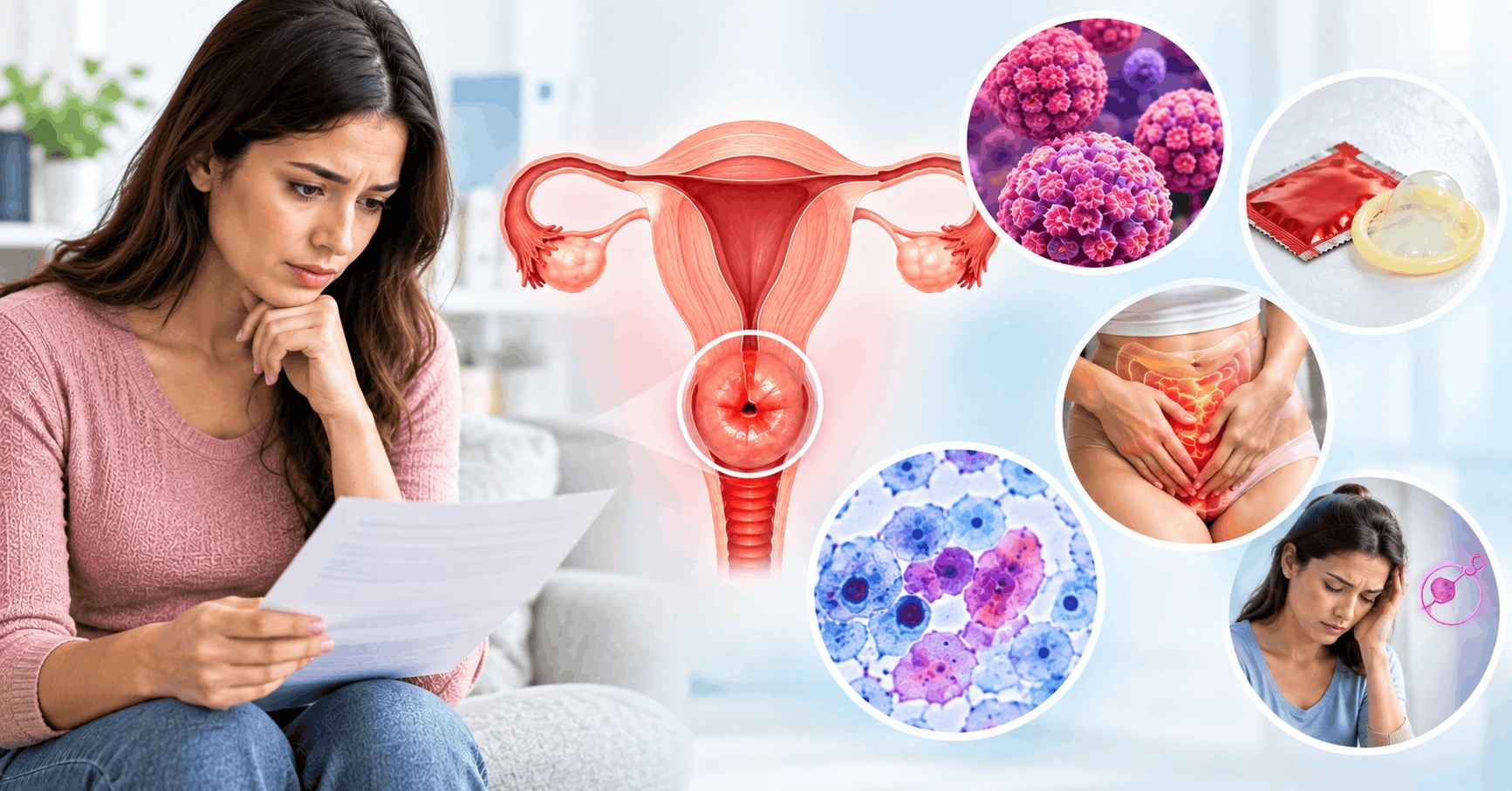
There are a few reasons cells can look abnormal. Some need follow-up. Some are simple to fix. Here are the main ones.
HPV (Human Papillomavirus)
HPV is the number one cause of abnormal Pap results.
It’s incredibly common. The CDC says nearly everyone who is sexually active will get HPV at some point. About 13 million people in the US get a new HPV infection every year.
There are many types of HPV. Some are “high-risk” types that can cause cell changes. Types 16 and 18 are the most concerning. Together, they cause most cervical cancers.
But here’s the reassuring part. About 9 out of 10 HPV infections go away on their own within 2 years, according to the CDC. Your immune system does the work.
The problem is only when a high-risk type stays around for many years. That’s what slowly leads to more serious cell changes. A weaker immune system, from smoking, HIV, or medicines that calm the immune system (like those used for autoimmune disease), makes it harder to clear.
That’s why doctors often do an HPV co-test with your Pap. It tells them whether a high-risk HPV type is there, which helps them decide what to do next.
Other Infections (Yeast, Trichomoniasis, BV)
Infections that have nothing to do with cancer can also make cells look abnormal.
- Yeast infections can cause swelling and irritation that changes how cells look under the microscope.
- Trichomoniasis (“trich”) is a common STI that can cause inflammation and an ASC-US result.
- Bacterial vaginosis (BV) throws off the balance of bacteria in the vagina. Some research also links BV with HPV that sticks around longer.
The good news? When the infection is treated, the cells often go back to normal. Your provider may treat the infection and repeat the test later.
If you keep getting these infections, it’s worth finding the root cause instead of treating each one separately. For help distinguishing common symptoms, read our guide to BV vs. yeast infection. Many women look for doctors for yeast infections that keep coming back. We offer recurrent vaginal infection support and bacterial vaginosis support that look at gut health, hormones, and the vaginal microbiome together. Healthy bacteria matter here too. Our guide on probiotics explains what they can and can’t do.
Inflammation or Cervical Irritation
Sometimes the cells look off just because the cervix is irritated. This can happen from:
- Sex in the day or two before the test
- Being on your period, or just after
- An IUD
- A recent infection
- Douching or vaginal products
Low estrogen after menopause is another cause. The tissue gets thin and dry, and the cells can look abnormal. Doctors sometimes prescribe estrogen cream and repeat the test. If you’re going through this stage, our menopause and hormone wellness support and our guide to hormone replacement therapy may help.
HPV Test Results: What Positive and Negative Results Mean
If you had an HPV test, with or without a Pap, here’s what your results mean.
HPV negative. No high-risk HPV was found. Your risk of serious cell changes is very low. If your Pap was also normal, you’ll usually wait 5 years for your next test.
HPV positive. A high-risk type of HPV was found. This does not mean you have cancer or precancer. It means your provider will want to keep a closer eye on things. What happens next depends on:
- Your Pap result, if you had one
- Whether you have HPV 16 or 18
- Your past results
- Your age
Some people are told to repeat the test in a year. Others are sent for a colposcopy.
What if you’ve been negative for years and now test positive? It can be a new infection. It can also be an old one that was hiding and became active again. HPV can stay quiet in the body for years. It doesn’t always mean a partner was unfaithful.
What if your Pap was abnormal but HPV was negative? That’s usually reassuring. Mild changes without HPV are very unlikely to be serious. Your provider may just repeat the test later.
Next Steps After an Abnormal Pap Smear
This is where most people’s questions are. What actually happens now?
It depends on your results. For mild changes like ASC-US with negative HPV, you may just repeat the test in 1 to 3 years. For more serious changes, or HPV 16 or 18, you’ll likely be sent for a colposcopy.
Here’s what each step looks like.
Colposcopy
A colposcopy is a closer look at your cervix using a magnifying tool called a colposcope. It stays outside your body. It’s like a pair of binoculars on a stand.
It feels a lot like a Pap test. You lie in the same position, and a speculum is used. Your provider puts a mild vinegar solution on your cervix. This makes any abnormal areas turn white so they’re easier to see.
It takes about 10 to 20 minutes. Most people say it’s uncomfortable, not painful. You might feel some pressure or a slight sting from the vinegar.
On a UK cancer support forum, one woman said her whole appointment took under 15 minutes. It felt like a smear test, and she had period-like cramps for a day after. Her advice: the worry before was worse than the procedure itself.
Tip: take a pain reliever like ibuprofen about an hour before, if it’s safe for you.
Cervical Biopsy
If your provider sees anything unusual during the colposcopy, they’ll take a biopsy. That means removing a tiny piece of tissue, about the size of a grain of rice, to send to the lab.
It usually feels like a quick, sharp pinch or a cramp. Some people barely feel it. Others find it stronger, especially when more than one sample is taken.
After a biopsy, you may have:
- Light bleeding or spotting for a few days
- Dark or brown discharge (from a medicine used to stop bleeding)
- Mild cramps
Avoid sex, tampons, and douching for a few days, or as long as your provider tells you.
Results usually take 1 to 3 weeks. Some people wait up to 4.
Biopsy Findings: Cervical Intraepithelial Neoplasia (CIN)
Biopsy results often use the letters CIN. It’s a grading system for how much of the cervix lining has changed. CIN is not cancer.
| Grade | What it means | What usually happens |
|---|---|---|
| CIN 1 | Mild changes | Usually goes away on its own. Watched with repeat tests, no treatment needed. |
| CIN 2 | Moderate changes | Usually treated. In younger women, sometimes watched closely instead, since it can also clear. |
| CIN 3 | More serious changes | Treated promptly. Not cancer, but could become cancer over time if left alone. |
Sometimes the biopsy grade is higher than the Pap suggested. One woman on shared that her Pap showed low-grade changes, but her biopsy came back CIN 2/3. She felt overwhelmed. That does happen. The good news is that this stage is very treatable.
Treatment for High-Grade Cervical Cell Changes

If you have CIN 2, CIN 3, or AIS, your provider will likely recommend removing the abnormal cells. These treatments work very well. Most people need only one treatment.
The options include:
- LEEP. A thin wire loop with a mild electrical current removes the abnormal area. Done in the office with numbing medicine. Takes about 10 to 20 minutes. This is the most common treatment.
- Cone biopsy (cold knife cone). A cone-shaped piece of tissue is removed with a scalpel. Usually done in a hospital with anesthesia.
- Laser therapy. A laser burns away the abnormal cells.
- Cryotherapy. The abnormal cells are frozen off. Done in the office.
- Hysterectomy. Removing the uterus. Rarely needed, only when other treatments haven’t worked or for certain glandular changes.
What’s LEEP like? A woman on r/PreCervicalCancer who had one for CIN 3 said the numbing shot made her heart race for a moment, but she felt nothing during the procedure and was feeling fine two days later. Another found the end of the procedure stung. Afterward, cramps, tiredness, and some discharge for a few weeks are normal.
Once treated, the abnormal cells are gone. But you’ll need closer follow-up for a while, since HPV can cause changes again.
Pregnancy and Treatment for High-Grade Cervical Cell Changes
If you’re pregnant and get an abnormal result, the plan usually changes a little.
- A colposcopy is safe during pregnancy.
- A biopsy may be skipped or delayed unless cancer is a real concern. Bleeding can be a bit heavier during pregnancy.
- Treatment is usually postponed until after you give birth. High-grade changes grow slowly, so waiting a few months is generally safe.
There’s a reason for the wait. Treatments like LEEP or cone biopsy can, in rare cases, weaken the cervix. That can raise the risk of early birth or miscarriage. So your provider will weigh the timing carefully.
Most people get a recheck about 6 weeks or more after delivery. Many find the changes have improved by then.
Who Should Get a Pap Test? Screening Guidelines
Guidelines changed recently, so here’s what’s current.
American Cancer Society (updated December 2025):
- Ages 25 to 65: An HPV test every 5 years is preferred.
- Self-collected samples are now accepted. That means you can swab yourself instead of having a speculum exam. If your self-collected test is negative, repeat it in 3 years.
- If HPV-only testing isn’t available, a co-test (HPV + Pap) every 5 years, or a Pap test alone every 3 years, is fine.
- Under 25: Screening is not recommended.
USPSTF (the government task force, 2018 guidance, update in progress):
- Ages 21 to 29: Pap test every 3 years.
- Ages 30 to 65: Pap test every 3 years, HPV test every 5 years, or both every 5 years.
When can you stop? After 65, if you’ve had regular normal results, you can usually stop. Ask your provider first. More than 20% of cervical cancers are found in women over 65, mostly in those who weren’t screened well before.
You may need more frequent tests if you:
- Have had abnormal results or CIN 2+ before
- Have HIV or a weakened immune system
- Were exposed to the drug DES before birth
- Had an organ transplant
Had a hysterectomy with your cervix removed, and no history of precancer? You usually don’t need screening anymore.
Can I Have a Pap Test While Pregnant?
Yes. It’s safe. Many providers do one at your first prenatal visit if you’re due.
It won’t hurt the baby. Your cervix has more blood flow during pregnancy, so light spotting afterward is normal. Heavy bleeding, cramps that don’t stop, or fluid leaking is not normal, so call your provider if that happens.
Outlook: What Happens After Treatment?
The outlook is very good. Treatment for precancer works in the large majority of people, and it stops cancer from ever forming.
After treatment, you’ll have closer follow-up for a while. That usually means an HPV test around 6 months after treatment, then yearly tests until you’ve had a few clear results in a row. After that, you’ll go back to less frequent screening. But you’ll still need regular tests for many years, usually at least 25.
Some people do get abnormal cells back. One woman says on Reddit that she needed a second procedure within two years and felt let down. It’s frustrating, but follow-up is exactly how it gets caught early again.
Most people go on to have normal results, normal sex lives, and healthy pregnancies after treatment.
Tips for Prevention
You can’t control everything, but these steps lower your risk a lot:
- Get the HPV vaccine. It’s recommended at ages 11 to 12, and can start at 9. Adults up to 26 should get it if they missed it. Some adults 27 to 45 may benefit too, so ask your provider. It’s already working. Cervical cancer cases in women ages 20 to 24 are falling about 11% a year.
- Keep up with screening. This is the most important one.
- Use condoms. They lower the risk of HPV, though they don’t block it completely.
- Don’t smoke. Smoking makes it harder for your body to clear HPV.
- Treat vaginal infections like BV and trich, and look into why they keep coming back.
- Support your immune system. Good sleep, good food, and managing stress all help your body clear HPV.
Being Proactive, Not Reactive: Take Control of Your Cervical Health
An abnormal Pap result can make you feel like your body let you down. It didn’t. The test did its job. It found something early, while it’s easy to handle.
The best next move is to be proactive.
Keep track of your results over the years. Know which test you had and when you’re due again. Ask questions at your visits. “Was I tested for HPV?” “What type?” “What’s my next step, and when?” You have every right to know.
Then look at the bigger picture. Your immune system is what clears HPV. Things like long-term stress, poor sleep, low vitamin levels, gut problems, and hormone imbalance can all affect how well it works. So can vaginal infections that keep coming back.
That’s where a root-cause approach helps. Functional medicine looks at how all your systems work together, not just one test result. The right functional medicine testing can show imbalances that standard checkups miss.
Our proactive women’s wellness assessment is built for exactly this. It’s a full look at your hormones, gut, immune health, and more, working alongside your regular gynecologist.
You don’t have to wait for the next scary result to take charge of your health.
Frequently Asked Questions
Does an abnormal Pap smear always mean I have cancer?
No. Most abnormal Pap smears are not cancer. Abnormal just means some cells look different. Many are caused by HPV that goes away on its own, or by infections that are easy to treat. Less than 1% of abnormal results turn out to be cervical cancer.
How common are abnormal Pap smear results?
Very common. About 3 million women in the US get an abnormal result each year. Most never develop cervical cancer.
What happens after an abnormal Pap smear? Will I need a colposcopy?
Not always. For mild changes like ASC-US with a negative HPV test, you’ll usually just repeat the test in 1 to 3 years. More serious changes, or a positive test for HPV 16 or 18, usually lead to a colposcopy.
Can an abnormal Pap smear go back to normal on its own?
Yes, often. Mild changes like CIN 1 usually go away on their own. About 9 out of 10 HPV infections clear within 2 years as your immune system fights them off.
Should I tell my partner about an abnormal Pap smear result?
That’s your choice. There’s no rule that says you have to. HPV is so common that partners often share it already, and there’s no approved HPV test for men. If you test positive for HPV or another STI, it’s kind to let your partner know so they can watch their own health. An abnormal result is not a sign that anyone cheated.
Worried About Cervical Health or Recurrent Vaginal Infections? We Can Help!
At Conscious Medicine, we know how stressful an abnormal result can feel. You want answers, and you want to feel in control again.
We work alongside your gynecologist to look at the whole picture. That means your immune health, hormones, gut health, and vaginal balance, all of which play a part in how your body handles HPV and infections.
If you’re dealing with BV, yeast infections, or other vaginal infections that keep coming back, our bacterial vaginosis support program finds out why, not just how to treat the next one.
Want to see everything we offer? Here’s what we do. We’re here when you’re ready.