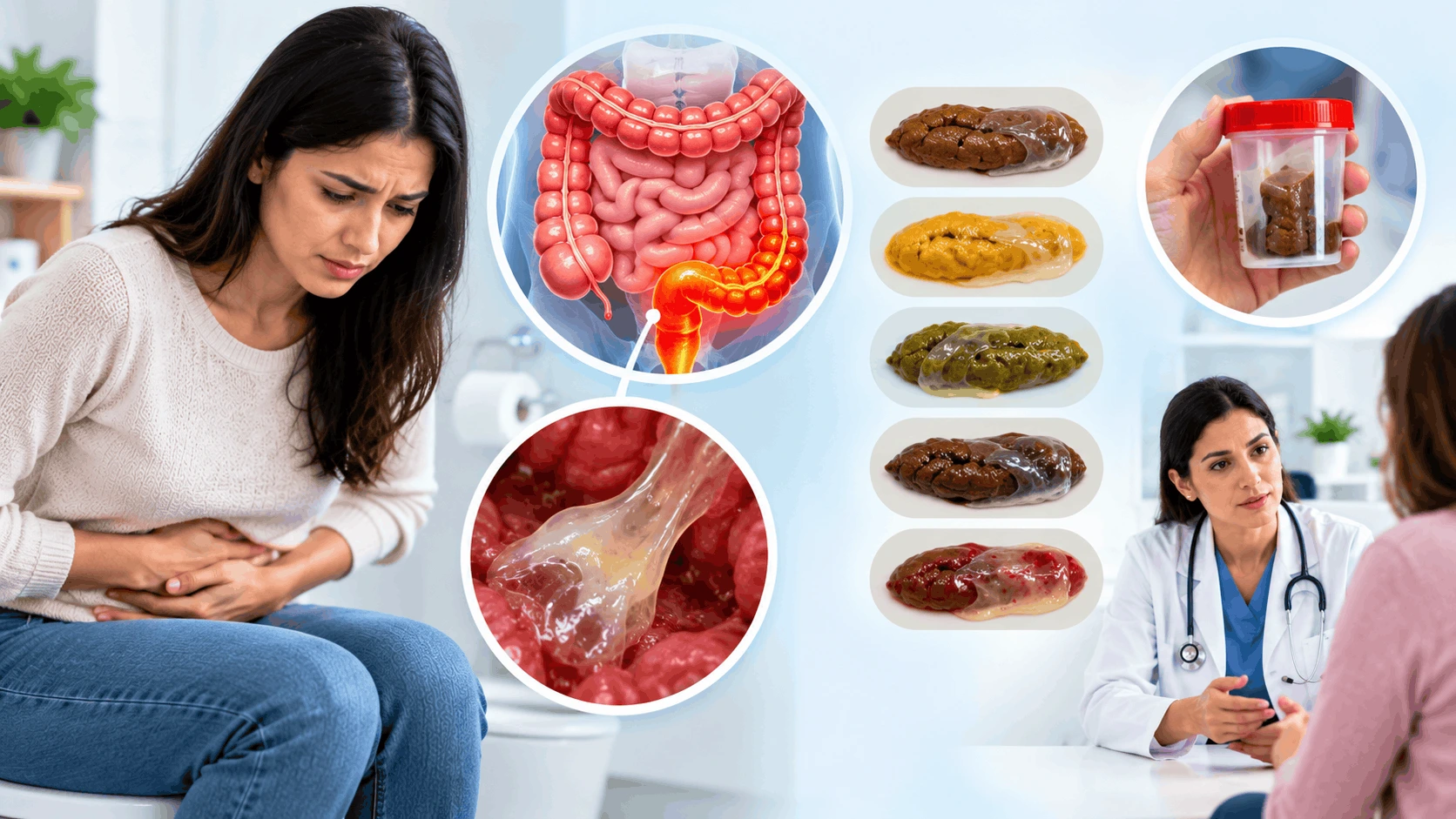
You just got up from using the bathroom. You looked down and saw something strange. Not blood. Not old food. Just a clear or white, slimy thing mixed in with your poop. Now you’re standing there wondering if this is okay or if something is wrong with you.
Here’s the good part first. A little bit of mucus in your poop is normal most of the time. Your gut makes it every day, and you never even notice.
But how much you see, what color it is, and what else you’re feeling can change things fast.
This guide, “Mucus in Stool: Causes, Colors, and When to See a Doctor“, explains what’s normal, what each color means, what causes it, and when you should stop guessing and just call a doctor.
What Is Mucus in Stool?
So here’s the thing about mucus. Your gut’s been making it this whole time, every single day, and you probably never think about it once.
It’s a thin coating inside your intestines. Keeps stomach acid and bacteria from tearing up the tissue underneath.
Helps stool slide out too, instead of getting stuck halfway. Most days you won’t notice any of this happening. It’s just background noise, basically.
Is it normal to have some mucus in your poop?
Yeah, totally normal. Your body’s been doing this since you were a baby. A bit of clear or whitish mucus shows up, you flush, you move on with your morning.
What you want to keep an eye on is change. Suddenly there’s way more than usual. Or the color’s wrong, not what you’re used to. That’s the part worth noticing. Not the mucus existing in the first place; that’s just normal plumbing.
What does mucus in poop look like?
Clear, sometimes a little whitish. Thin, kind of jelly-like if you had to describe it.
Might be stuck right onto the stool or just sitting by itself in the water. Now when it turns thick and stringy, or shows up yellow, green, or mixed with blood, that’s a different animal entirely.
What Does the Color of Mucus in Stool Mean?
Honestly, color tells you a lot before any doctor touches a test kit.
White mucus in stool
Happens all the time with IBS. Looks like little pale threads running through the stool.
Not drinking enough water does the same thing, so does being backed up, since hard, dry stool scrapes extra mucus loose as it moves along.
Yellow mucus in stool
This one usually points to inflammation somewhere. Crohn’s, ulcerative colitis, gallbladder issues- any of these can turn things yellow.
Stomach hurting on top of that? Just call your doctor. Don’t sit on it hoping it fixes itself.
Green mucus in stool
Food moving too fast through your gut means bile never fully breaks down, and that’s what tints everything green.
Eating tons of spinach does it too. Dark food dye, same deal. Sometimes it’s an infection behind the scenes.
Green mucus by itself, nothing to panic over usually. Throw in a fever or sharp cramping, though, and that changes the whole picture.
Clear mucus in stool
Just the regular stuff. Your gut’s pumping it out constantly, no drama attached. A faint streak now and then, don’t even think twice.
| Color | Likely Cause | Urgency Level |
|---|---|---|
| Clear | Normal gut lining protection | Low |
| White | IBS, dehydration, constipation | Low to moderate |
| Yellow | Crohn’s disease, ulcerative colitis, gallbladder issues | Moderate to high |
| Green | Fast digestion, infection, certain foods | Low to moderate |
Common Causes of Mucus in Your Stool
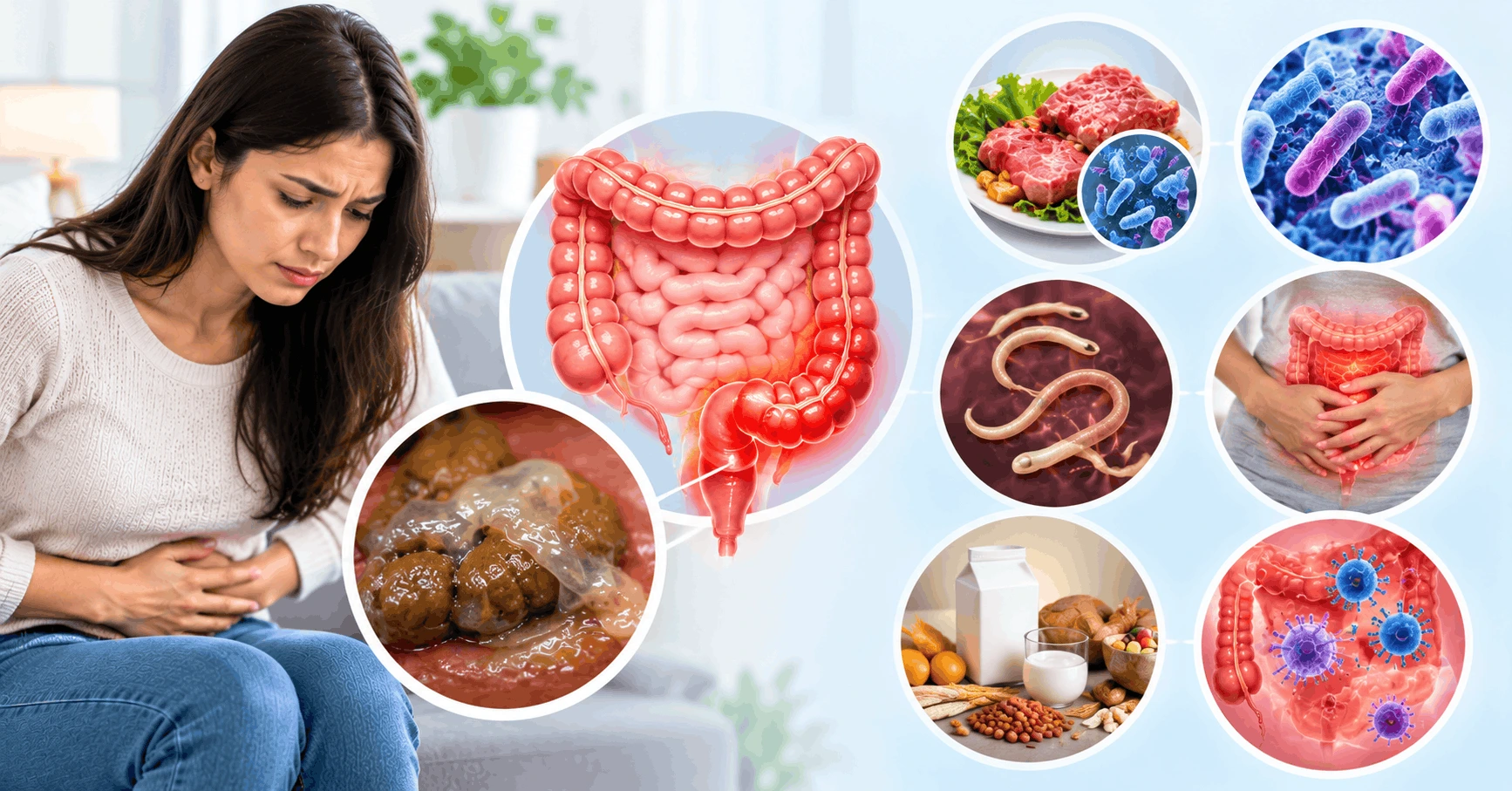
Plenty of stuff can set your gut off, making extra mucus. Some of it clears up on its own, no help needed. Other stuff, you’ll need an actual doctor for.
Irritable bowel syndrome (IBS)
Probably the number one reason you’re even reading this article. Food triggers it. Stress triggers it. Even your hormones mess with it.
Mucus climbs, bloating and cramps show up, and your bathroom schedule turns unpredictable; one week you’re constipated, next week it’s the opposite.
Can’t tell if it’s IBS or just something you ate? SIBO die-off versus food intolerance walks through how to tell the two apart.
Crohn’s disease and ulcerative colitis
Both fall under IBD. Gut lining swells up; sometimes actual sores form on it. Mucus with blood mixed in shows up a lot here.
Cramping, that sudden need-to-go-right-now feeling, comes along too. Flares eventually settle down, but the inflammation underneath usually doesn’t just pack up and leave.
Bacterial or parasitic infections
Salmonella, Shigella, C. diff- these attack your gut lining straight on. Parasites take their time instead; sometimes you won’t even notice anything’s wrong at first.
Either way, your gut strikes back with more mucus. Fever and sudden diarrhea tend to follow close behind.
Food intolerances and sensitivities
Gluten, dairy, that whole group of carbs called FODMAPs- way more people get tripped up by these than you’d guess.
Keep eating something your gut can’t stand, and the mucus just keeps coming back around. Food intolerances, sensitivities, and allergies help narrow down what’s actually to blame.
Anal fissures or hemorrhoids
These are lower down, nowhere near deep in your gut. A small tear or a swollen vein; either can leak mucus along with a bit of blood when you’re going. Hurts during or right after? That’s usually your culprit right there.
Intestinal obstruction
A blockage stops solid stool dead in its tracks. Liquid and mucus still manage to squeeze through, though, so you end up noticing more mucus even while everything else slows way down.
Bad bloating, vomiting, zero gas passing at all- that’s an emergency room situation, not a wait-it-out situation.
I Feel Like I Need to Poop, But Only Mucus Comes Out
Most of the time, it happens that people feel like they want to go to the washroom but nothing happens:
Why this happens
Tenesmus- that’s the actual term for it. Your rectum feels completely full, sends the signal to go, and when you sit down, nothing but mucus shows up.
Swelling in there confuses the nerves, so they keep firing off alarms even though there’s barely anything left to pass through.
IBS causes this a bunch. Proctitis too. Ulcerative colitis, infections in the rectum, same story all around. And stress just cranks up the volume on an already sensitive gut.
On Reddit, one person wrote a post titled “I pooped mucus only, I’m really worried.” A lot of people replied saying the same thing happens to them.
Most said it felt scary at first but turned out to just be swelling inside, not anything dangerous.
Is it a medical emergency?
Not really, no. Once or twice, don’t even worry about it. Keeps happening over and over, though, especially alongside blood, bad pain, fever, or weight just falling off without trying; that’s when you book the appointment.
White Stuff in or Around Stool
Here are some different things that arise:
White stringy mucus in stool
People search this constantly, probably because it looks alarming in the moment. Most of the time it’s nothing scary at all.
In one Reddit post, a person said they spent five years worried about mucus in their poop before learning it was just part of having IBS.
Another thread had people say the white, stringy mucus gets worse during a flare and calms down after. Most people said it was nothing to panic about.
IBS is a frequent cause. Dehydration and low fiber too, since dry stool drags extra mucus along with it on the way out.
White coating on feces
A thin white film, same handful of usual suspects. Mild dehydration. Constipation. An IBS flare acting up. Shows up every single day with pain or diarrhea tagging along? Worth getting that looked at properly.
When Mucus in Stool Is a Red Flag?
A few combinations mean it’s actually time to call someone, not just wait around hoping.
- Blood mixed into the mucus could mean IBD, an infection, hemorrhoids, or, in rare cases, cancer.
- Fever or bad abdominal pain alongside the mucus could mean infection, diverticulitis, or an IBD flare that’s currently active.
- Weight dropping off without you trying, alongside the mucus, could mean malabsorption, IBD, or, rarely, cancer.
Any of this sticking around longer than a few days, make the call already. No reason to keep waiting. People online say the same thing too. Many said blood in the mucus is what made them stop waiting and finally go see a doctor.
The Functional Medicine View: Why Your Gut Is Producing Excess Mucus
Here are some reasons that may be behind mucus in poop:
Gut inflammation and the mucosal barrier
Picture your gut lining as more of a screen door than an actual solid wall. Nutrients pass through just fine; toxins and undigested bits are supposed to stay out, assuming the screen’s intact.
Inflammation tears holes right through it, and your gut responds by cranking out more mucus trying to patch things up. Let that damage sit around long enough and repair just can’t keep pace with it anymore.
Leaky gut and microbiome imbalance
Once that lining’s torn up, stuff starts leaking into your bloodstream that was never supposed to end up there at all. Leaky gut, that’s what people call it.
Sets off immune reactions way beyond just your stomach and intestines. A gut full of the wrong bacteria just speeds this whole process along even faster. The root cause of leaky gut breaks down exactly how that chain reaction plays out.
Dietary triggers (gluten, dairy, FODMAPs)
Not every food bothers every gut the same way, but gluten, dairy, FODMAPs tend to hit sensitive guts harder than most other stuff.
Cut these out for a few weeks and mucus usually settles down right along with everything else. Foods to eat on a leaky gut diet gives you a decent starting point if you’re not sure where to begin.
How Conscious Medicine approaches gut health
We’re not out here just trying to make mucus disappear and calling that a win.
Our team actually digs into what’s causing the inflammation in the first place: bad bacteria, a hidden food sensitivity, a microbiome that’s totally out of whack, whatever’s actually going on underneath.
Gut health and digestive dysfunction walks through exactly how we test for this stuff and what treatment actually ends up looking like.
Diagnosis and Testing
The following tests can help people diagnose mucous in stool:
Stool culture and ova & parasites test
Checks a stool sample for bacteria, parasites, parasite eggs, the whole lot. Usually the first thing ordered when infection seems likely, especially after travel or eating something that just didn’t sit right.
Colonoscopy, when it’s needed
Gives your doctor an actual direct look at your entire colon using a thin camera. Gets ordered when mucus shows up alongside blood, unexplained weight loss, or colon cancer running somewhere in your family. Catches polyps early too, well before they’d ever turn into anything serious.
Functional stool testing (GI-MAP)
Goes a lot further than your basic stool test. One single panel: gut bacteria, inflammation markers, digestion, all measured together at once. Functional medicine doctors lean on functional medicine testing like this to see the whole picture instead of just stopping at “well, no infection found here.”
Treatment Options for Mucus in Stool
Have a look at the following set of treatments for mucous in stool:
Conventional: antibiotics, antispasmodics, IBD medications
Infections get hit with antibiotics targeted at whatever bug’s actually causing trouble.
IBS often responds well to medication that calms down gut spasms. IBD usually needs something stronger, anti-inflammatory drugs or meds that calm the immune system, to protect that lining over the long run.
Functional: elimination diet, probiotics, gut-healing protocols
Usually kicks off with cutting certain foods out to pinpoint your real triggers. Drop gluten, dairy, and processed sugar for a set stretch, and mucus often eases up within just a few weeks.
Probiotics help rebuild healthier bacteria. Gut-healing protocols go to work directly repairing the lining itself.
Not sure which probiotic actually makes sense for you? Probiotics benefits, risks, and myths sorts through all that noise. Want something a bit gentler than antibiotics? Here’s how to naturally kill bad bacteria in your gut.
To Wrap It Up
Mucus in your stool is part of normal digestion. Your gut makes it every day to protect itself and keep things moving. A small amount, clear or white, isn’t something to worry about.
What matters is change. More mucus than usual. A new color. Blood mixed in. Fever, weight loss, or pain that sticks around. Those are the signs that mean it’s time to stop guessing and get checked out.
Most causes of mucus in poop, things like IBS, food intolerances, or mild dehydration, are fixable once you know what’s driving them. Others, like IBD or an infection, need real treatment, not just time. Either way, you don’t have to figure this out on your own.
If your gut has been off for a while, or the mucus just doesn’t add up with anything else going on, get it looked at. Book a gut health consultation at Conscious Medicine in Alpharetta, GA and get a real answer instead of more guessing. Check out what we do to see how our whole approach works.
Curious about other gut stuff that might be related? Right side abdominal pain causes and treatments covers another complaint that overlaps a lot with this one. SIBO sound familiar at all?
Top 8 causes of SIBO breaks down what usually triggers it. Still dealing with irregular bowel movements too? Fiber supplements for digestive health might actually help out.
And if you’re after the bigger picture on fixing gut issues for good, how to heal your gut and reclaim your health is a solid place to start digging in.
Frequently Asked Questions
Is it normal to see white stringy stuff in my poop?
A little, sure, that’s fine. Usually just IBS, dehydration, or constipation at play. Seeing a ton of it every single day, though, get that checked out properly.
Should I be worried if I push and only mucus comes out?
Not after just one time, no. Keeps happening again and again, though, especially with blood or pain mixed in, go get it looked at.
What does yellow mucus in stool mean?
Usually points to inflammation somewhere. Crohn’s, ulcerative colitis, gallbladder trouble- take your pick. Tell your doctor if this color keeps showing back up.
Can stress cause mucus in your stool?
Yep, it can. Stress messes with how your gut moves and how sensitive it gets overall. People living with IBS often notice way more mucus during stressful stretches; the gut and brain are wired together tighter than most people realize.
Is mucus in stool a sign of colon cancer?
It can be, though it’s pretty rare, honestly. Colon cancer sometimes causes mucus mixed with blood, alongside weight loss and bathroom habits that just won’t settle down. Most mucus cases trace back to something way less serious than that. Still, symptoms refusing to quit deserve an actual screening, not more guessing.